My GSoC 2020 Journey
From writing only C++ to a summer of open source with the Python Software Foundation
I have been a student developer under the Python Software Foundation for the last 4 months as part of the Google Summer of Code program, and I successfully completed it on 31st August 2020, the last day of this year’s program! So, for the unacquainted: what is Google Summer of Code (GSoC)?
It is an annual program in which university students from all around the globe contribute to open source during their summer break (starting in April/May and ending in August):
- Organizations register for the program around February with the projects that will take part.
- Interested students discuss project ideas with the organizations and apply with their proposals.
- Accepted students then code throughout the summer, and Google offers them a stipend.
So, what’s my background story?
I was finishing my 2nd semester studying Information Technology at Maharaja Agrasen Institute of Technology, Delhi, India, when a friend who was taking part in GSoC’19 told me about the program. I saw how much he had learnt and grown as a programmer during and after it.
At the time, I only wrote code in C++ and had no prior knowledge of Python or any other language. So I started learning Python, and after a few weeks was introduced to the world of Machine Learning. That’s when I started contributing to open source. I looked for organizations and projects that caught my interest and started contributing, mostly because I was getting to learn a lot of cool new stuff!
In March 2020, I submitted my proposal, and on 4th May I was accepted as a student for the summer.
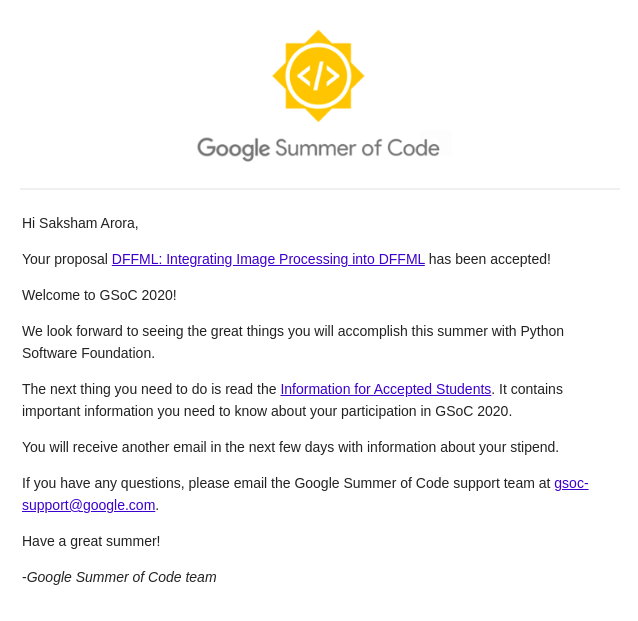
My project: Integrating Image Processing into DFFML
DFFML is a machine learning project that provides APIs for training and testing models on datasets using various machine learning frameworks such as scikit-learn, making it easier for anyone to train and test on their datasets regardless of their programming knowledge.
The project, Integrating Image Processing into DFFML, aimed to add functionality to DFFML for image processing tasks such as image classification, so that anyone using DFFML could get their desired results in a clean and user-friendly way.
Before this project, there was no definite and fast way of training and testing machine learning models in DFFML on visual data. Most machine learning algorithms tend to fit very closely to the training data, especially when there isn’t enough of it. Part of the problem is that visual data is very complex, so models have higher-dimensional inputs and many parameters to fit. DFFML needed a less time-consuming and accurate way of performing image processing tasks.
The project was divided into 2 main parts:
- Adding ways to read image datasets and perform pre-processing operations on them.
- Adding state-of-the-art machine learning models to perform image processing tasks such as image classification and object detection.
To read what I did this summer in detail, see the final report. For a week-by-week description, check out my weekly blogs.
How can someone get selected in this program?
A lot of students get confused about how this program works. Here I will try to clear up the main obstacles students face while getting started with open source and GSoC, in the simplest way possible.
1. How do I start contributing to open source?
Learn how to use version control systems like Git and GitHub, and understand how they work. Plenty of articles, online courses, and YouTube videos cover this well.
2. How do I prepare, and which organization or project should I pick?
Preparation: There is no proven way of preparing that guarantees acceptance. It depends on the skills you have for the specific organization or project you are applying to.
Organization/Project: Browse the GSoC organizations list and filter by the projects and languages you’re interested in. Then:
- Read their contribution guidelines.
- Look for good first issues to build your confidence. Yes, it’s that simple! (I know it seems intimidating at first, it did to me too, but taking the first step is always the hardest.)
- Move on to bigger issues and establish yourself as a hard-working contributor.
- Don’t hesitate to ask the project admins your doubts.
3. Do I need to be an exceptional programmer to participate?
Not necessarily. A basic understanding of programming and of the area of the project you’re interested in, along with enthusiasm and a craving to learn and explore, is what you need!
Consistency. I believe that putting in the hard work is the only thing between you and your goals. You’ll have a lot of distractions along the way, but consistency always leads to excellence.
If you have participated in GSoC and feel I’ve missed something important, let me know and I’ll make sure to add it to this article.
Thank you for reading!