Profiling and Optimizing Python Serialization Pipelines
Finding hidden costs in nested schemas, validation, copying, and request-local state
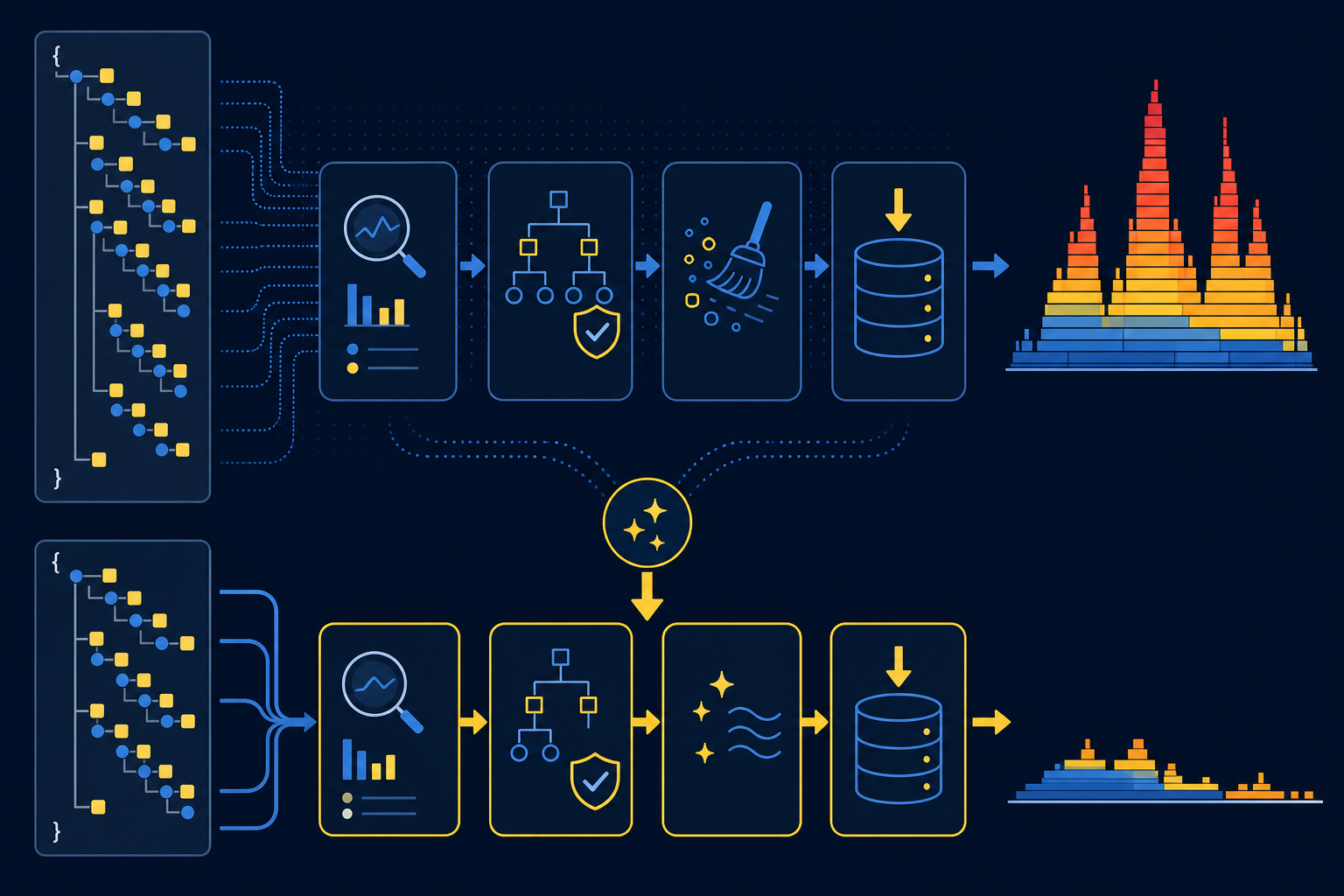
A slow API backed by a database and search engine naturally raises questions about SQL, networking, and cluster capacity. In metadata-heavy Python applications, much of the time may instead be spent copying dictionaries, traversing nested schemas, sanitizing strings, and validating the same structure more than once.
One diagnostic profile of an update with several thousand nested items took several seconds. Python deserialization and record validation dominated the trace, although the profile did not independently isolate persistence time.
Measure the complete request
The diagnostic comparison ran the same operation with a normal payload, a payload containing several thousand items, and a larger stress case. The samples slowed to multiple seconds as the collection grew. Each was a single-run observation for locating work, not a latency distribution or a measured post-optimization result.
A sampling profiler showed a path similar to:
HTTP request
  -> service update
  -> schema load
  -> metadata schema
  -> items list
  -> item schema
  -> profile schema
  -> groups list
  -> group schema
  -> sanitization
  -> record validation
  -> commit
No function was catastrophic by itself. The cost was inexpensive work repeated thousands of times through a deeply nested schema:
small cost × nested depth × collection sizeDistinguish fixed and scaling costs
A useful performance model is:
total time = fixed request cost + per-item cost × item countSchema construction, permission setup, and request initialization are mostly fixed. Nested deserialization, string processing, and validation scale with collection size. Fixed-cost improvements help every request, while per-item improvements matter most for large payloads.
Benchmarking only the smallest valid payload can hide the scaling bottleneck.
Nested schema validation is convenient but not free
A schema such as:
class ItemSchema(Schema):
    profile = fields.Nested(ProfileSchema, required=True)
    groups = fields.List(fields.Nested(GroupSchema))
provides clear validation and useful errors. In a large list, however, every item incurs field lookup, type checks, nested traversal, hook dispatch, custom validation, error collection, and allocation. Multiple nested groups multiply those operations.
Nested schemas are not inherently a mistake, but unbounded arrays expose their cost. Depending on the API, the response may be a documented size limit, a bulk-import path, different handling for trusted internal data, enrichment outside request time, fewer redundant layers, or safe schema reuse. Removing validation entirely is rarely the right first step.
Watch for duplicate validation
A request may validate input, business rules, the stored object against JSON Schema, the search document, and frontend input. The captured request established two substantial layers: input-schema deserialization and JSON Schema validation before commit. It did not measure the other possible layers.
For each rule, identify whether it validates external input, enforces a domain invariant, protects persistence, or only improves an error message. Also check if an earlier layer already proved the same property. Give every invariant one clear owner instead of removing checks indiscriminately.
deepcopy is often a hidden linear traversal
A response serializer needed to transform nested values without mutating the source object. It began with:
items = deepcopy(payload["items"])This copied every item dictionary, nested profile, policy object, and group. If the serializer changes only a few branches, copying the whole tree is unnecessary.
A targeted copy can be safer and cheaper when it follows every path the transformation mutates:
items = []

for source_item in source_items:
    item = source_item.copy()

    if "groups" in source_item:
        item["groups"] = [
            transform_group(group)
            for group in source_item["groups"]
        ]

    if "policy" in source_item:
        policy = source_item["policy"].copy()
        if "label" in policy:
            policy["label"] = transform_label(policy["label"])
        item["policy"] = policy

    items.append(item)
The copy depth must match the mutation depth: every branch later modified must be copied. Replacing deepcopy() with dict.copy() is unsafe if nested dictionaries are mutated because only the outer dictionary is protected.
Identify all mutation paths, copy those paths, test that the source remains unchanged, and then benchmark. For ordinary acyclic containers, deepcopy() traverses the reachable object graph, so its cost follows the total structure rather than only the top-level list length.
String sanitization scales with field count
Unicode repair is valuable at trust boundaries but can become expensive across every label, profile field, group name, policy label, and identifier in a large payload. Thousands of items may contain tens of thousands of strings.
In the captured update path, Unicode sanitization ran during input deserialization for each sanitized string field. The trace did not establish HTML cleaning or output serialization as material hotspots.
Potential improvements include avoiding repeated input sanitization during output serialization, using cheaper format checks for identifiers, distinguishing plain Unicode from HTML-capable fields, and not reprocessing unchanged values during internal round trips. Profile representative Unicode data before replacing a sanitizer.
Security transformations belong at explicit trust boundaries.
Schema construction can become repeated work
Many service layers build a new schema tree for every operation:
schema = PayloadSchema(**schema_args)
result = schema.load(data)
This avoids shared mutable state but repeatedly reconstructs nested fields and validators. Reuse can reduce fixed overhead only if schemas are safe across concurrent requests.
The main danger is request-specific state stored on the schema:
schema.context["identity"] = current_userA singleton schema with mutable context can leak data between concurrent requests.
Context variables remove one barrier to schema reuse
Python’s ContextVar provides context-local data without putting it on a shared schema object:
from contextvars import ContextVar

schema_context = ContextVar("schema_context")
A service wrapper can set and reset it around an operation:
token = schema_context.set({
    "identity": identity,
    "permission_check": permission_check,
})

try:
    return shared_schema.load(data)
finally:
    schema_context.reset(token)
Under the framework’s supported execution model, this isolates invocation state from the schema and restores the previous context even when validation fails. The finally reset is essential; without it, data can leak into later work in the same execution context.
Moving request data off the schema prevents one shared-state collision. It does not prove that an instance is concurrency-safe. Mutable custom fields, hooks, constructor state, and caches still require audit and concurrent testing.
Constructor arguments can still prevent reuse
Removing mutable context is not sufficient if runtime behavior is encoded through constructor arguments:
RuleSchema(policy=policy_a)
RuleSchema(policy=policy_b)
If stored constructor state changes behavior, one shared instance or compiled implementation may be incorrect across uses.
One solution is subclassing by stable intent:
class PolicyASchema(RuleSchema):
    policy = POLICY_A
Another is supplying genuinely dynamic policy through request context:
policy = schema_context.get()["policy"]Runtime state hidden in constructors makes caching, compilation, and reuse harder.
Treat a Marshmallow major upgrade as an architecture migration
A serialization-library upgrade needs more justification than “newer is faster.” The sequence below is a proposal, not a measured result. In the inspected implementation, context-variable plumbing existed, but schemas were still instantiated per operation; global compilation and caching were neither enabled nor benchmarked.
Moving away from mutable schema context can simplify shared instances while creating room to remove compatibility branches and deprecated field arguments, standardize decorator signatures, review unknown-field handling, centralize context management, benchmark reuse, and evaluate optional compilation. A Marshmallow major upgrade also affects custom fields, hooks, extensions, error handling, partial loads, and unknown-field behavior, so it remains an architecture migration.
A safe sequence is:
- Introduce
ContextVarwhile still on the current major version. - Migrate consumers away from mutable schema context.
- Refactor constructor-configured schemas.
- Add compatibility tests for load, dump, partial load, and unknown fields.
- Upgrade the library.
- Remove temporary compatibility paths.
- Enable schema reuse.
- Benchmark again.
Separating preparation from the version switch makes failures easier to diagnose.
JIT compilation cannot fix an algorithmic problem
Schema compilation can reduce dispatch and method-call overhead, but every item still must be processed.
If processing is:
O(total scalar fields visited + total nested collection elements)JIT compilation may improve the constant factor, not the scaling class. Compiled functions can also be unsafe when constructor state is absent from the cache key. That is a source-inspected correctness risk, not a measured compilation result.
Before proposing global compilation caches, verify schema keys and test constructor variants, schemas created from partial, partial loads, custom fields, hooks, and output equivalence. Valid-looking but semantically wrong data is worse than slow data.
Caching is not automatically useful
Caching transformed or serialized output helps only when inputs recur. Its design must cover deterministic keys, user-specific output, invalidation, mutation after retrieval, memory bounds, and whether hashing costs as much as recomputation. Request-specific serialization may have too little reuse to justify that complexity, so measure hit rate first.
Bulk work may need a separate execution model
A single payload with thousands of nested items is not the same workload as an import of thousands of independent records. The background workflow below is an unimplemented proposal whose validation and transaction semantics would need separate design.
For very large payloads, a bulk workflow may:
- accept and store the uploaded source;
- create a background job;
- validate entries in chunks;
- report errors with row numbers;
- write valid data transactionally; and
- publish progress and final status.
A queue does not make the work cheaper; it changes latency, reliability, and user experience. Background processing also needs idempotency, retries, observability, cancellation, and a clear partial-failure policy.
Benchmark behavior, not isolated helpers
A useful benchmark suite covers realistic schema loads and dumps, the full service update, persistence, response serialization, memory growth, and concurrent requests.
Test at multiple representative sizes:
small, medium, large, and stress-case payloadsRecord median and high-percentile latency, CPU time, peak memory, result correctness, input mutation, and error behavior.
A microbenchmark can prove that a copying function became faster while the endpoint remains unchanged because another validator dominates.
Avoid unproven percentage claims
Estimates such as “caching should improve this by 40%” are hypotheses until measured under the real workload.
Stating both the evidence and its limits keeps the work reproducible.
Backend and frontend performance are connected
After backend serialization improves, the browser may become the visible bottleneck. Returning thousands of items still leaves React to mount components, initialize forms, and render DOM nodes. The browser-side work: progressive mounting, lazy modals, memoization, search precomputation, and drag-state handling is covered in Making React Forms Fast With Thousands of Rows.
The practical pattern is to profile the complete operation, separate fixed from scaling costs, and remove unnecessary work without weakening invariants. Broad copies, repeated sanitization, duplicate validation, and request state embedded in schemas deserve scrutiny before compilation or caching. If synchronous semantics no longer fit, design a separate bulk path. Then measure the full endpoint again.
A profiler locates cost of work and the architecture determines whether the work needs to happen.